

Europe’s understanding of China remains overly ideological, lacking a deep and rational grasp of China’s social transformation, governance logic, and evolving international role. This cognitive bias has undermined the pragmatism of certain European policies toward China. The future trajectory of China–Europe relations will depend on three key dynamics: Europe’s internal political evolution, the spillover effects of U.S. policies, and China’s strategic adaptability.
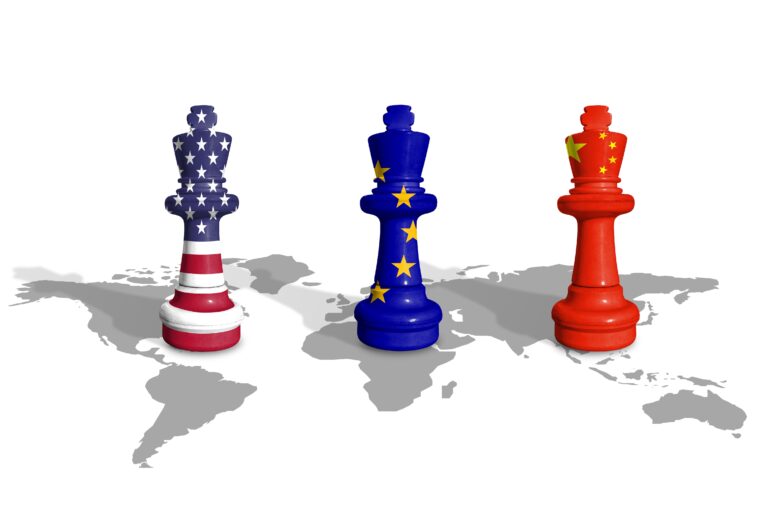
China–U.S.–Europe Relations: A Difficult Balance Amid Great Power Rivalry
The China–U.S. relationship is facing severe challenges. Entering Donald Trump’s second term, his “America First” doctrine has evolved from a political slogan into concrete policy. Although China is reluctant to let competition define bilateral ties, the U.S. has intensified multi-dimensional pressure on China across economic, political, and security domains.
Competition remains the central theme of U.S. policy toward China. During his first term, Trump demonstrated a distinctly hardline approach, vigorously promoting economic and technological “decoupling” while linking restrictions on China’s technological development to U.S. national security concerns. Deeply influenced by the logic of “outcompeting China”, Trump’s administration emphasized maintaining absolute leadership in critical technologies such as artificial intelligence, making it difficult to alleviate the mutual exclusivity of development between the two countries in the short term.
“Transactional” continues to be Trump’s hallmark diplomatic style. In his second term, Trump is expected to maintain his “deal-oriented” diplomacy, favoring the use of tariffs, sanctions, and export controls as tools of maximum pressure to extract concessions from China on bilateral issues such as trade, fentanyl, and TikTok, as well as on broader geopolitical matters like the Russia–Ukraine conflict. Meanwhile, the negotiation model dominated by personal will has undermined the institutionalized dialogue mechanisms that had been partially restored under Biden, making China–U.S. relations more volatile and vulnerable to the fluctuations of bilateral bargaining.
Development amid volatility has become the “new normal” of China–U.S. relations. Under Trump’s transactional diplomacy, the two sides may reach temporary consensus on certain issues, but such progress often just reflects tactical adjustments rather than structural breakthroughs. For instance, although the TikTok negotiations and tariff discussions have yielded short-term solutions, they have not addressed the underlying structural trade issues. Trump’s inherently transactional nature also means that once he perceives insufficient benefit from engaging China, he may swiftly shift toward confrontation. Moreover, the “China hawks” could also constrain Trump from pursuing policies that appear overly conciliatory. Overall, while the outcomes of the TikTok negotiations and recent leader-level communications have injected a degree of warmth into bilateral ties, the path toward genuine normalization between China and the United States remains long and arduous.
As for transatlantic relations, although the alliance has long been the cornerstone of the Western order since the Cold War, Trump’s “America First” approach is profoundly eroding its institutional foundation. The relationship remains bonded but increasingly fraught with fissures.
First, the transatlantic alliance is undergoing structural erosion. Trump’s second term has transformed “America First” from rhetoric into concrete action, expressing strong dissatisfaction with Europe’s “free-riding” on U.S. security commitments and imposing harsher defense spending demands,[1] creating both fiscal and political pressure for European allies. Meanwhile, U.S. Vice President J.D. Vance’s criticisms of Europe’s multilateralism and democratic institutions in the Munich Security Conference[2] have further deepened European disappointment and resentment.
Second, widening transatlantic divergences are shaking the foundation of mutual trust. For Trump, alliances are transactional arrangements quantifiable in material terms. He tends to bundle defense, trade, and technology issues together, coercing Europe into alignment with U.S. positions on China, industry policy and others. When European states fail to display sufficient loyalty, Washington may again resort to tariffs or export restrictions as instruments of pressure.[3] Consequently, the transatlantic partnership, though unlikely to collapse, is increasingly shifting from a community of shared values to one governed by interest calculations, becoming progressively “de-moralized” and “de-emotionalized”.
Europe’s strategic anxiety is rising sharply, and transatlantic value divergences are becoming more pronounced. The Trump administration’s ideological and behavioral departure from traditional “liberal internationalism” toward a more realist and isolationist “America First” strategy signifies that the U.S. no longer wishes to bear the burdens of alliance maintenance or the responsibilities of sustaining international institutions. Washington also places less emphasis on ideological issues and may bypass Europe altogether to negotiate directly with other major powers, including Russia, on key international matters.
Confronted with growing U.S. unpredictability, Europe has been compelled to enhance its own security, energy, and industrial capacities. Yet, internal divisions and resource constraints have prevented it from achieving genuine strategic autonomy. As a result, Europe is assuming greater security and economic responsibilities while simultaneously feeling increasingly marginalized. Though the transatlantic alliance endures, it can no longer return to its golden age of value-driven and trust-based cooperation.
China–Europe relations, as the most malleable component of the China–U.S.–Europe triangle, combine strong potential for cooperation with persistent structural frictions. On one hand, in recent years China-Europe relations have witnessed dense, multi-level interactions.[4] For instance, France continues to play its traditional “bridge” role; high-level exchanges between China and Germany remain frequent; [5]and mechanisms such as the China–EU Strategic Dialogue and High-Level Economic and Trade Dialogue continue on a regular basis, preserving the vitality of institutional communication.
On the other hand, frequent exchanges have not translated into durable strategic trust. The EU’s tripartite definition of China as a partner, competitor, and systemic rival encapsulates its internal contradictions, seeking cooperation while maintaining ideological and strategic vigilance. On issues such as human rights, governance, and market access, Europe often adopts a confrontational posture. The outbreak of the Russia–Ukraine conflict in 2022 further strained ties: despite China’s repeated emphasis on supporting political solutions,[7] opposing the use of tactical nuclear weapons,[8] and upholding sovereignty and territorial integrity,[9] European public opinion still generally believes that Beijing failed to exert sufficient pressure on Moscow, viewing China–Russia relations as an “indirect factor” hindering conflict resolution. This perception gap has weakened the emotional and political foundations of bilateral trust, pushing China–Europe relations to a low point.
Europe is also struggling to find a delicate balance between China and the United States. Its China policy must account for Washington’s stance, as it remains dependent on American security guarantees yet cannot forgo the economic benefits of cooperation with China. As a result, Europe’s approach toward China exhibits growing divergence in position, inconsistency in attitude, and fragmentation in action.
Core Factors Shaping China–Europe Relations
The evolution of China–Europe relations is driven by multiple interrelated factors, among which trade and technological frictions, security considerations, and ideological differences stand out as the three most representative variables. The “U.S. factor” constitutes the most significant external variable influencing China–Europe interaction, while the shifting global balance of power between China and Europe represents the underlying structural variable. As the international order undergoes profound transformation, both sides must redefine their roles and expectations toward each other.
For a long time, economic and trade relations have been regarded as the “ballast” of China–EU relations, maintaining relative stability despite fluctuations in political atmosphere. China and the EU are each other’s major trading partners, with deeply intertwined industrial and supply chains. European enterprises have long been embedded in the Chinese market, while Chinese manufacturing complements Europe’s technological advantages. However, in recent years, this cooperative foundation has shown signs of strain. European concerns over trade deficits, asymmetric market access, and state subsidies have been mounting, especially in sectors such as electric vehicles, photovoltaics, and wind energy. Meanwhile, technology has become a new focal point of competition. Europe seeks to preserve an open global innovation ecosystem that safeguards its interests in exports and R&D, yet U.S. political pressure and security constraints are forcing it to limit the scope and depth of technological cooperation with China under the influence of geopolitics.[10]
At the same time, security anxieties are reshaping Europe’s strategic posture, with the Russia–Ukraine conflict serving as the key catalyst for this transformation. Since the outbreak of the conflict, Europe’s perception of the “Russian threat” has intensified,[11] leading to a surge in defense expenditures and deepening its dependence on NATO and the U.S. for security guarantees. Against this backdrop, European vigilance toward China–Russia relations has also grown considerably, accompanied by growing dissatisfaction with Beijing’s continued engagement with Moscow.[12] Consequently, China–Europe relations have suffered visible damage. China’s ongoing political coordination and energy trade with Russia are often interpreted by European commentators as “indirect support” for Moscow. Many Europeans also believe that China “could have but did not” use its influence over Russia to accelerate an end to the conflict, and this expectation gap has further eroded mutual strategic trust.
Ideological and value-based differences remain the most enduring and fundamental barriers in China–Europe relations. Europe defines itself as a “community of values,” upholding democracy, human rights, and the rule of law as core principles of its foreign policy and emphasizing its “normative power.”[13] China, by contrast, insists on sovereign equality, non-interference in internal affairs, and the diversity of development models, emphasizing each state’s right to choose its own path. These divergences over political systems, human rights, and regional governance have long existed. European criticism of China’s domestic issues and selective media portrayals often strain bilateral ties.
In recent years, such cognitive differences have been amplified across multiple issues. During the COVID-19 pandemic, European skepticism toward China’s epidemic control measures and data transparency stirred public opinion.[14] Following the outbreak of the Russia–Ukraine conflict, many in Europe claimed that China’s partnership with Russia warranted a reassessment of Europe’s China policy based on the perceived “China–Russia nexus.”[15]
At its core, Europe’s understanding of China remains overly ideological, lacking a deep and rational grasp of China’s social transformation, governance logic, and evolving international role. This cognitive bias has undermined the pragmatism of certain European policies toward China. It is foreseeable that ideological divergence will persist and continue to exert a long-term influence on China–Europe relations.
Prospects for China–Europe Relations: Moving Forward amid Challenges and Opportunities
The future trajectory of China–Europe relations will depend on three key dynamics: Europe’s internal political evolution, the spillover effects of U.S. policies, and China’s strategic adaptability. Against the backdrop of mounting geopolitical competition and growing domestic uncertainty, the bilateral relationship faces simultaneous pressures and opportunities for constructive recalibration.
Europe’s internal political transformations are profoundly shaping its approach toward China. In recent years, right-wing and populist forces have risen rapidly across the continent, challenging the EU’s policy coherence and strategic stability.[16] Far-right parties which advocating “Europe First” tend to adopt conservative and nationalist positions on fiscal, climate, migration, and foreign policy matters. This trend weakens the EU’s ability to coordinate external affairs and makes its China policy more susceptible to domestic political cycles.
Furthermore, Europe itself is far from monolithic. Substantial differences exist within the Union. France promotes the vision of “strategic autonomy” and seeks to reduce dependence on U.S. security guarantees; Germany adopts a more pragmatic approach to China; whereas Central and Eastern European states, influenced by historical and geostrategic factors, prioritize maintaining close defense ties with the United States. Divergent national priorities and strategic perceptions make it difficult for the EU to establish a unified China policy, leaving its internal consensus fragile and inconsistent.
Externally, U.S. policy remains the most critical variable affecting China–Europe relations. Following the failure to broker peace in the Russia–Ukraine conflict, Trump has reportedly pressured Europe to impose tariffs as high as 100% on Indian and Chinese goods in an attempt to force Moscow into concessions.[17] He is likely to continue leveraging the “America First” agenda to push Europe to align its economic, technological, and security policies with those of Washington. Such pressure forces Europe into a difficult dilemma in the U.S.–China rivalry: while its security still relies on the U.S. and the NATO framework, its economy and industrial supply chains remain deeply tied to China. Excessive alignment with the U.S. could undermine Europe’s economic interests and its pursuit of strategic autonomy.
In comparison, China has adopted a relatively stable and pragmatic approach toward Europe. Beijing has long pursued a “dual-track strategy”: strengthening institutional cooperation with the EU as a whole while simultaneously deepening bilateral relations with major member states. This approach is not intended to weaken European integration but rather reflects a realistic understanding of Europe’s political diversity and decentralized decision-making mechanisms.
In practice, China–France relations have achieved tangible results in energy, aerospace, agriculture, and cultural exchange; China–Germany relations remain dynamic in manufacturing, the automotive industry, and electric mobility; while China’s partnerships with Spain, Hungary, and Greece have yielded progress in infrastructure, education, and tourism. These pragmatic engagements provide resilience and stability for the broader China–Europe relationship. At the same time, China fully recognizes the profound impact of the “U.S. factor” on Europe’s strategic autonomy and acknowledges that Europe is unlikely to formulate a completely independent China policy in the short term. Accordingly, Beijing remains patient and composed, striving to mitigate misperceptions through institutionalized dialogue, economic cooperation, and multi-level exchanges while avoiding unnecessary turbulence triggered by single-issue disputes.
Despite persistent challenges, the potential for cooperation between China and Europe remains substantial. In an era when the global governance system is being reshaped, both sides share a natural interest in defending multilateralism and promoting international cooperation. China and Europe can continue to coordinate in areas such as climate change, public health, food security, counterterrorism, and global development to preserve openness and inclusiveness in addressing global challenges.
On one hand, China’s extensive influence across the Global South and Europe’s strength in institutional design and governance experience can jointly contribute to a more balanced and inclusive global governance framework. On the other hand, Europe’s expertise in green finance, carbon markets, and digital regulation complements China’s competitive edge in new energy technology, clean energy equipment, and digital infrastructure. In the future, both sides could deepen cooperation by jointly developing green industries, aligning standards for sustainable investment, and co-shaping rules for artificial intelligence ethics and data governance. In the digital domain, China and Europe can explore coordinated pathways for cross-border data flows and digital trade governance while respecting each other’s “digital sovereignty,” thus preventing technological competition from evolving into systemic confrontation.
Finally, strengthening strategic communication is essential to preventing misperceptions and further political estrangement. In today’s increasingly uncertain and competitive international environment, China–Europe relations are highly susceptible to external shocks. Maintaining high-level strategic dialogue and multi-level communication channels is crucial for stabilizing policy expectations and managing contingencies. To this end, both sides should promote regular exchanges among think tanks, academic institutions, and civil society organizations, building multi-dimensional networks of trust across political, economic, and social spheres. Institutionalized communication, rather than emotional reactions, will be key to ensuring that China–Europe relations remain rational, predictable, and resilient amid global uncertainty.
[1]NATO. Defence expenditures and NATO’s 5% commitment. 27 August 2025. https://www.nato.int/cps/en/natohq/topics_49198.htm
[2] Munich Security Conference 2025 Speech by JD Vance and Selected Reactions. https://securityconference.org/assets/02_Dokumente/01_Publikationen/2025/Selected_Key_Speeches_Vol._II/MSC_Speeches_2025_Vol2_Ansicht_gek%C3%BCrzt.pdf
[3] Euro News. Trump threatens EU with 35% tariffs if $600bn investment pledge unfulfilled. 5 August 2025. https://www.euronews.com/my-europe/2025/08/05/trump-threatens-eu-with-35-tariffs-if-600bn-investment-pledge-unfulfilled
[4] China’s Ministry of Foreign Affairs. China-EU relations. Last updated in August 2025. https://www.mfa.gov.cn/gjhdq_676201/gjhdqzz_681964/1206_679930/sbgx_679934/
[5] CCTV News. On German Chancellor Scholz’s China visit: Accompanying German business executives optimistic about the Chinese market, will continue to increase “investment in China. 15 April 2024. https://news.cctv.com/2024/04/15/ARTI0nkfAbXjawUYYOURLehe240415.shtml
[6] The Diplomatic Service of the European Union. EU-China Relations factsheet. 7 December 2023. https://www.eeas.europa.eu/eeas/eu-china-relations-factsheet_en
[7] Xinhua News. “China Urges International Community to Advance Political Resolution of Ukraine Crisis”. 5 September 2025. https://www.news.cn/world/20250905/c5db85e8786a438c938aeaac9bc3da46/c.html
[8] CISS. Zhou Bo: China can facilitate negotiations between Russia and NATO to resolve the nuclear crisis in Europe. 4 November 2022. https://ciss.tsinghua.edu.cn/info/china_wzft/5409
[9] CISS. Resolving the Ukraine crisis should adhere to the “four shoulds.” 29 April 2022. https://www.ciis.org.cn/yjcg/sspl/202204/t20220429_8534.html
[10] Brookings. Between Washington and Beijing: How Europe fits into US-China strategic competition. 11 September 2025. https://www.brookings.edu/articles/between-washington-and-beijing-how-europe-fits-into-us-china-strategic-competition/
[11] The Guardian. 4 October 2025. https://www.theguardian.com/world/2025/oct/04/europe-needs-to-get-serious-about-threat-posed-to-it-by-russia-ukraine-minister-says
[12] Mercator Institute for China Studies. China-Russia alignment: a threat to Europe’s security. 26 June 2024. https://merics.org/en/report/china-russia-alignment-threat-europes-security
[13] Geopolitique.eu. https://geopolitique.eu/en/articles/europe-as-an-international-normative-power-state-of-play-and-perspectives/
[14] Carnegie Endowment for International Peace. https://carnegieendowment.org/research/2020/07/how-the-coronavirus-pandemic-shattered-europes-illusions-of-china/
[15] ECFR. 16 September 2025. https://ecfr.eu/publication/great-changes-unseen-the-china-russia-nexus-and-european-security/
[16] International Bar Association. The year of elections: The rise of Europe’s far right. 30 September 2024. https://www.ibanet.org/The-year-of-elections-The-rise-of-Europes-far-right
[17] The Guardian. 10 September 2025. https://www.theguardian.com/world/2025/sep/10/trump-asks-eu-to-impose-high-tariffs-on-india-and-china-to-put-pressure-on-russia